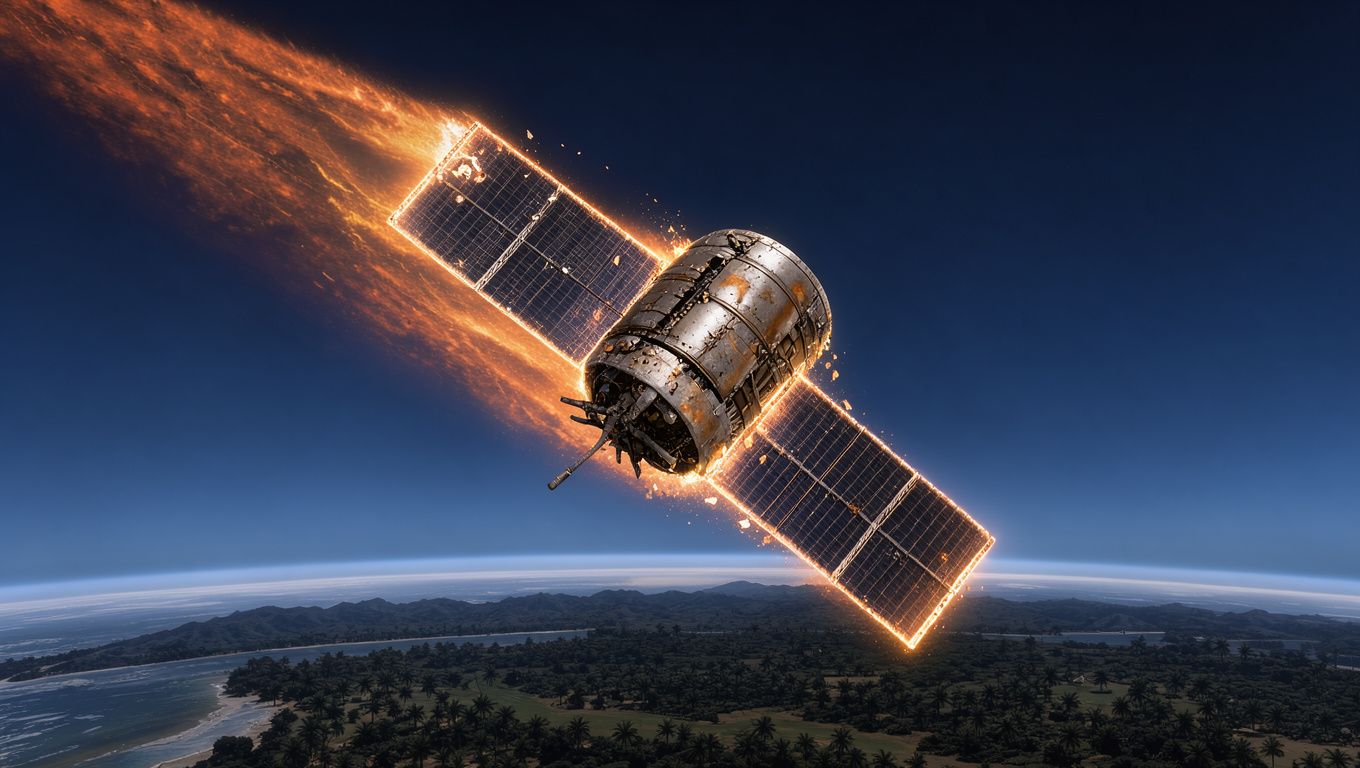
Swift telescope reentry: the end of a NASA mission meant to last two years
NASA's Swift telescope fell over Sumatra on November 4 after 22 years and a failed rescue attempt. Here is what happened and what it means.

The Swift telescope reentered on November 4 at 12.39 UTC (7.39 a.m. on the U.S. East Coast) over the Indonesian province of North Sumatra, according to the U.S. Space Force.123 The NASA observatory, launched in 2004 for a two-year mission, fell less than three months after the failure of the private spacecraft that was supposed to raise its orbit.41
What an uncontrolled atmospheric reentry means
Swift could no longer orient itself or make observations, so its reentry into the atmosphere could not be guided. The satellite came down on its own, with no one choosing where it would fall.5 In its forecasts before the reentry, NASA said that most of the telescope’s 1,452 kilograms would be destroyed passing through the atmosphere, but that some components could survive. Any fragments would have landed between 20.6 degrees south latitude and 20.6 degrees north.51 The risk of anyone being injured was estimated at about 1 in 2,100. After the fall there were no immediate reports of damage on the ground, while it was not yet known how much of the telescope had disintegrated.5423 According to NASA, the satellite passed through the upper atmosphere at about 22 times the speed of sound.1 Forecasts of the exact time changed over time. The day before, the Space Force had indicated 3:30 a.m. on November 4, U.S. East Coast time, while the reentry was recorded at 7:39 a.m. in the same time zone.543
Why Swift was losing altitude
The satellite was in good condition, but its orbit dropped partly because of strong geomagnetic storms caused by solar eruptions. Australia’s ABC reports intense solar activity in recent years.23 In October, Swift was orbiting about 171 miles (275 kilometers) above Earth and was commanded to end operations to prepare for reentry. The last scientific observation dates from October 20.546
The rescue attempt
NASA had entrusted a private company, Katalyst Space, with a mission to push Swift into a higher orbit. The three-armed robotic spacecraft, called LINK, failed to rendezvous with the telescope.542 According to Deutsche Welle, LINK had attitude control problems right after reaching space and began to spin out of control. The spacecraft then fell to Earth in September.23
What Swift did in 22 years
Swift was designed to study gamma-ray bursts, brief, intense flashes of radiation that astronomers regard as among the most powerful explosions in the universe. It detected and followed more than 2,000 of them.54 Its strength was speed. It had to detect a burst, relay its position to other observers and turn telescopes toward that spot before the glow faded, an operation that, according to chief scientist S. Bradley Cenko, generally took about a minute.4 The name “Swift” is not an acronym but evokes the spacecraft’s agility.4 The telescope also studied supernovae, black holes that destroy stars, stellar X-ray flares, asteroids and comets. According to Deutsche Welle, it contributed to nearly 7,000 scientific papers.3 The mission lasted 11 times longer than planned, just days short of 22 years. The satellite cost $500 million.3
This article was written by artificial intelligence from the sources cited, without human review. Automatic newsroom by Redazia.
Sources
Footnotes
-
Nasa’s 22-year-old Swift satellite telescope falls from orbit in fiery finale, South China Morning Post · World, 2026-11-04 ↩ ↩2 ↩3 ↩4
-
NASA Swift telescope plummets to Earth near Indonesia, ABC News Australia, 2026-11-04 ↩ ↩2 ↩3 ↩4 ↩5
-
NASA’s Swift space telescope plunges back to Earth in fiery demise, Deutsche Welle, 2026-11-05 ↩ ↩2 ↩3 ↩4 ↩5 ↩6 ↩7
-
NASA’s Swift space telescope crashes back to Earth after failed rescue attempt, Space, 2026-11-04 ↩ ↩2 ↩3 ↩4 ↩5 ↩6 ↩7 ↩8
-
Nasa telescope launched in 2004 to plunge back to Earth after failed rescue mission, The Guardian · World, 2026-11-03 ↩ ↩2 ↩3 ↩4 ↩5 ↩6 ↩7
-
Fin del telescopio Swift de la NASA: 22 años siguiendo el rastro de «las explosiones más potentes del cosmos», ABC (España), 2026-11-04 ↩