Russia's Deepfakes About the War in Ukraine: The Dobropillia Video
A Russian Defense Ministry video of Dobropillia was probably manipulated with AI. What the Financial Times and the ISW report about deepfakes.
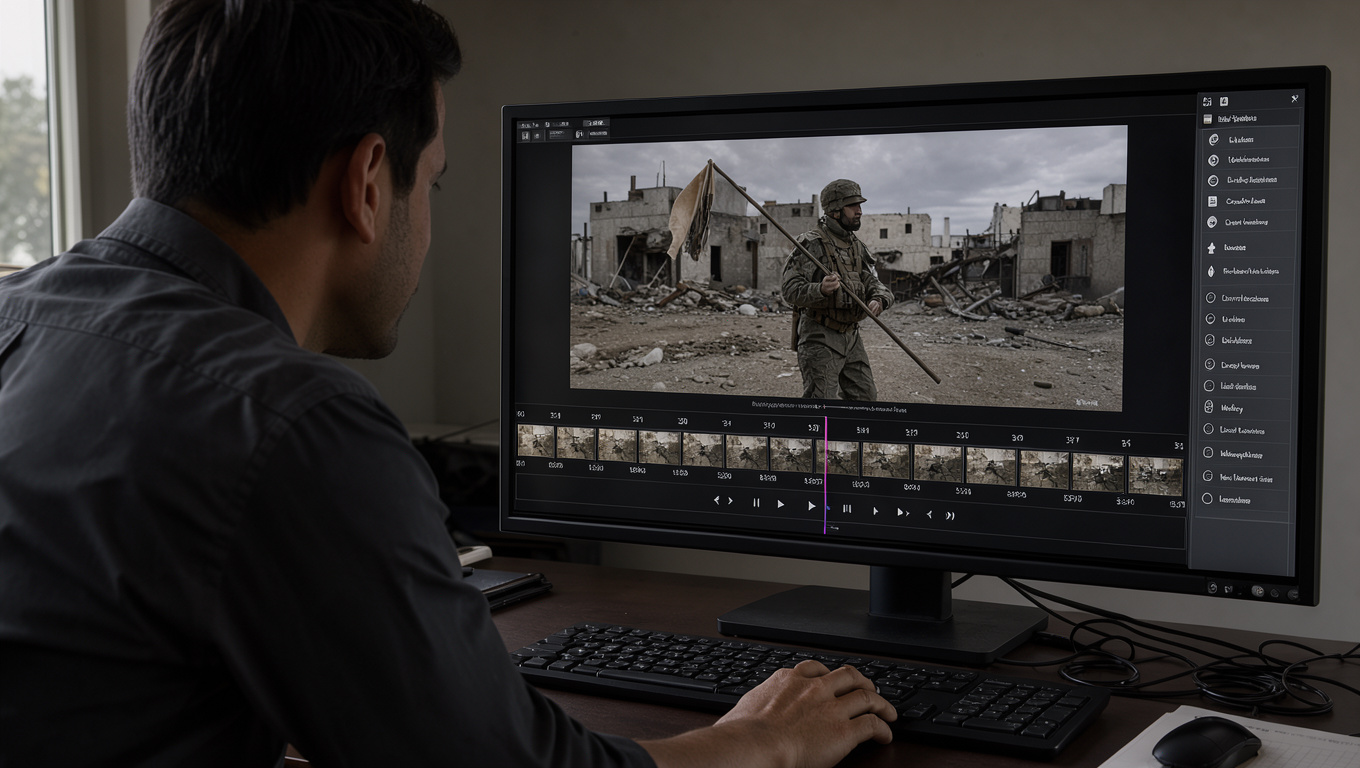
A video released in mid-October by Russia’s Defense Ministry shows a soldier waving a Russian flag in Dobropillia, in the Donetsk area, and according to Linkiesta it was probably manipulated with artificial intelligence. It is an example of a deepfake, that is, fake but realistic content created or altered with generative software, used to portray a military victory.1 The telltale sign is an anomaly in the image: at one point the flag changes orientation, as if it were attached to the pole from the opposite side. Linkiesta writes that the flaw cannot be explained by video compression or by the camera sensor.1
What happened in Dobropillia
The footage was included in a montage made public by the Russian ministry shortly before the commanders told Putin they had taken the city. According to Linkiesta, almost three weeks later the Ukrainian army still held positions in Dobropillia.1 The Financial Times has collected several similar cases, in which Russian forces and bloggers use AI to build a fabricated narrative of their advance. The Institute for the Study of War, back in September, had counted at least thirty-five videos that were in all likelihood created or edited with AI. They show soldiers with impossible proportions, flags that vanish among the vegetation and figures that suddenly disappear.1
Who makes these videos and who they are aimed at
According to Linkiesta, there is no centralized direction. Many videos may originate from individual units or from bloggers and then be amplified by state media and by the Defense Ministry itself.1 The Financial Times has reconstructed a chain in which the commander announces the capture and the news rises rank by rank up to the General Staff and Putin. By the time it reaches the top, the troops may already have withdrawn from the area. Subsequent orders would thus be based on a mistaken picture of the battlefield, with consequences for human losses as well.1 Linkiesta adds that the videos also support a narrative aimed at the outside world, that of a Ukrainian resistance close to collapse. It would serve to convince Western countries that supporting Kyiv is pointless.1
What changes
In her analysis for the Financial Times, Katya Arenina identifies as the most insidious outcome the possibility of inflating successes on the ground and giving Putin unwarranted confidence in the troops’ advances. The problem, therefore, could also concern decision-makers in Moscow, as well as international public opinion.1 Peter Dickinson of the Atlantic Council, interviewed by Forbes, links the practice to the Russian army’s problems that have emerged since the start of the invasion, from corruption to poor leadership. Linkiesta concludes that AI does not create the lie but inflates it with faster and more convincing tools.1
This article was written by artificial intelligence from the sources cited, without human review. Automatic newsroom by Redazia.