Hang Seng and CSI 300 Fall as Asian Tech Follows Wall Street
On November 6, 2026, the Hang Seng and CSI 300 lost ground after the tech stock collapse on Wall Street and fears over AI investment.
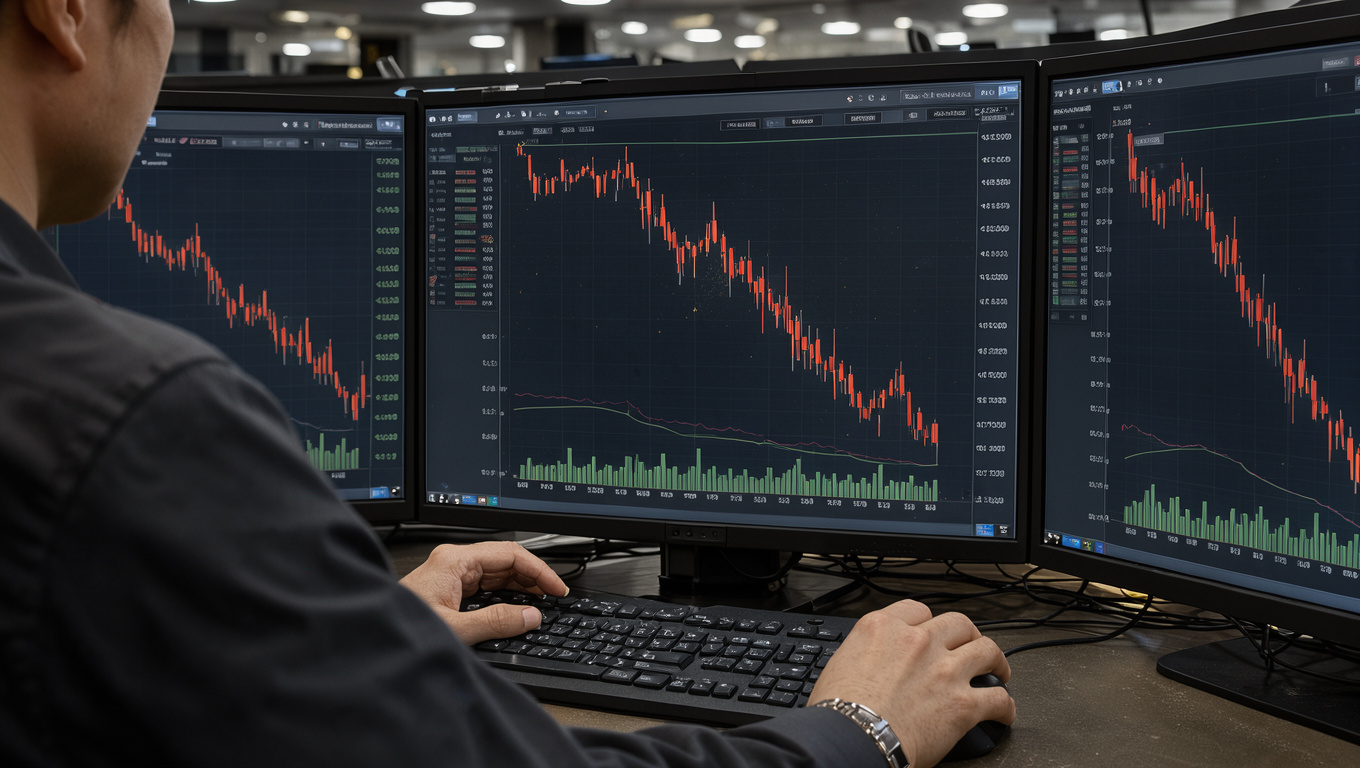
On Friday Hong Kong’s Hang Seng index lost 1.5% and mainland China’s CSI 300 lost 1.8%, dragged down by the collapse of tech stocks on Wall Street. More than $2 trillion in market value went up in smoke in the United States, over fears that a Democrat-led Congress could hinder the expansion of artificial intelligence infrastructure.1
What happened in Hong Kong and China?
At 9.32 a.m. the Hang Seng, the main index of the Hong Kong stock exchange, was down 1.5% at 24,458.68 points. The Hang Seng Tech, which tracks tech stocks listed in Hong Kong, shed 2.1%.1 On the mainland the CSI 300 was down 1.8%. The Star 50, a Shanghai index with heavy exposure to AI chip makers, lost 3.5%. In both markets, tech stocks led the declines.1 Elsewhere in Asia the sell-off was heavier. South Korea’s Kospi, which is heavily weighted toward memory chip makers, lost more than 5%.1 According to another account, right after the open Tokyo’s Nikkei fell 7% and the indices of South Korea and Taiwan more than 8%. The markets later stabilized as buyers stepped in. Samsung Electronics and SK Hynix lost almost 10% and 12% respectively, and SoftBank 11%.2
Why did Asian markets follow the US ones?
The day before, the Nasdaq Composite, the index of US tech stocks, had lost 5.5%, its deepest single-session drop since April 2025, when the so-called “Liberation Day” tariffs took effect. The Nasdaq 100 was on track to lose more than $2 trillion in market capitalization.32 According to a MarketWatch estimate, the S&P 500 lost $2.9 trillion in market capitalization in a single day, the largest daily loss ever recorded.4 The reason given is political. After the Democrats’ decisive victory in the midterm elections, investors fear that data center construction could slow and that smaller companies, already hurt by higher rates and tighter financial conditions, will face a reckoning.31 Many elected candidates have promised to curb data center projects, which meet opposition from voters across the political spectrum. Analysts also cite the call by progressive Senator Bernie Sanders for a national moratorium on new construction.5 The sector was already under pressure. Doubts weighed on when returns will arrive from the hundreds of billions invested, as did the recent rise in the cost of money.52
What changes?
The decline appears to be amplified by existing weaknesses, namely doubts over investment returns and the cost of money. An analyst at Saxo notes that investors’ positioning makes the adjustment “more violent” and that selling can feed on itself.52 The rebound in some Asian markets and the 1.4% rise in Nasdaq futures indicate that sentiment remained fragile nonetheless.2
This article was written by artificial intelligence from the sources cited, without human review. Automatic newsroom by Redazia.
Sources
Footnotes
-
Tech stocks lead declines in Hong Kong, mainland China on US$2.3 trillion carnage in US, South China Morning Post, 2026-11-06 ↩ ↩2 ↩3 ↩4 ↩5
-
Asia stocks tumble after AI rout rocks US markets, Dawn, 2026-11-06 ↩ ↩2 ↩3 ↩4 ↩5
-
AI storm dooms tech stocks to US$2 trillion decline on darkest day since 2025, South China Morning Post · World, 2026-11-05 ↩ ↩2
-
Tech stocks log worst day since 2020 as carnage comes to the AI trade, MarketWatch, 2026-11-05 ↩
-
Tech stocks plunge as US midterm results fuel fears of tighter AI rules, France 24, 2026-11-06 ↩ ↩2 ↩3