Agility Robotics Debuts on Nasdaq: Humanoid Robots Reach the Stock Market
Agility Robotics debuts on the Nasdaq via a $465 million SPAC deal. What a humanoid robot pure-play means and what the company's financials show.
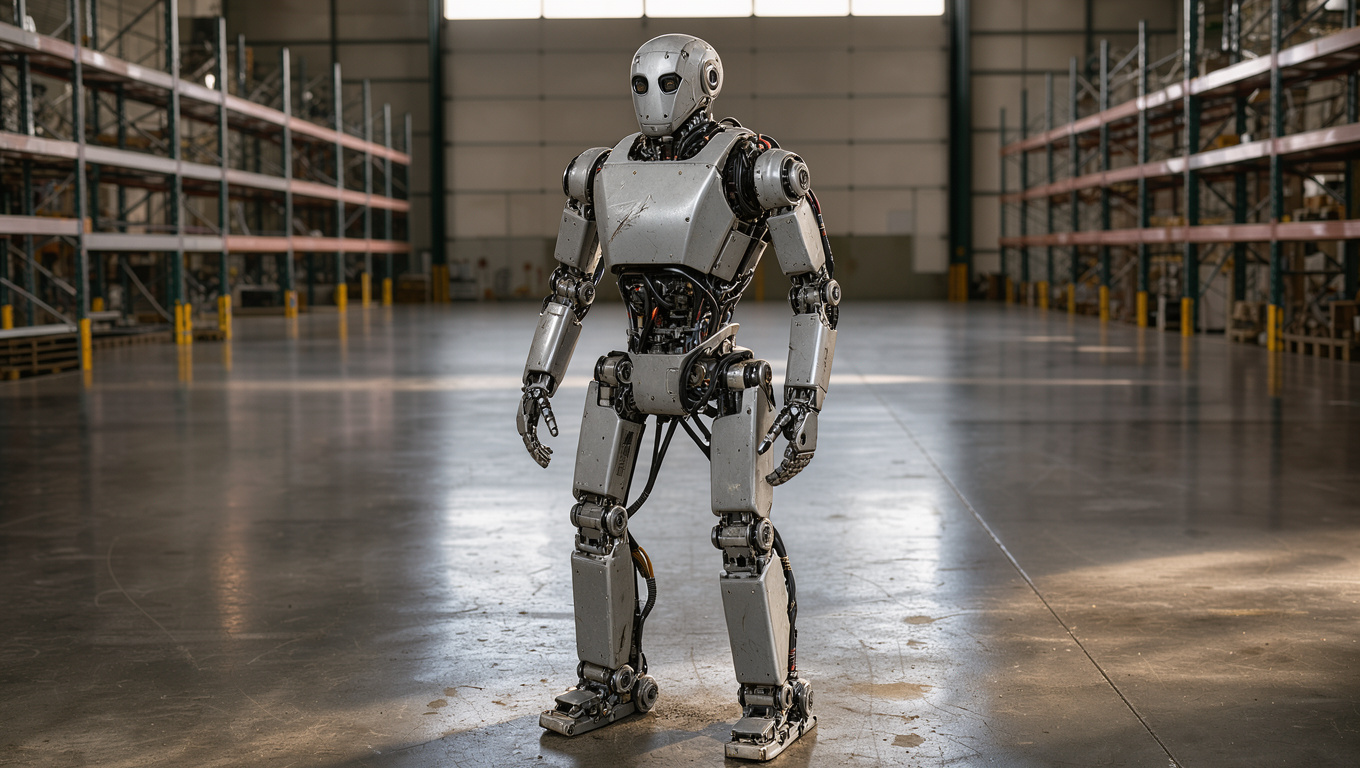
Agility Robotics, the American company that builds the Digit humanoid robot, debuted on the Nasdaq on November 5, 2026. TechCrunch calls it the first publicly traded company to focus exclusively on humanoid robots.12 That matters because a public company has to disclose its finances, and Agility’s show how far humanoid robots have come outside of demo videos.1
What a pure-play company is
Pure-play describes a company that does just one thing. For Agility, it means its entire business revolves around humanoid robots, unlike groups that develop them alongside other products.1
How the listing happened
Agility did not go for a traditional listing. It merged with Churchill Capital Corp XI, a SPAC (special purpose acquisition company), meaning a shell company that goes public with no operations of its own and then combines with a private company, which takes its place on the exchange.12 The deal and the related financing brought in $465 million, net of fees. According to TechCrunch, the funds come from retail investors and a private equity tranche.12 Agility will use the money to bring Digit 5, the robot’s new generation, to market and to increase its production capacity.2
What Agility does today
The company was founded in 2015 out of Oregon State University by a group of researchers working on how to make a two-legged robot walk safely. Today it deploys a number of Digit robots in industrial settings with nine customers, including Schaeffler, GXO, Toyota Motor Manufacturing Canada and Mercado Libre.1 Digit mostly moves heavy totes: at a GXO logistics center it has handled more than 100,000 of them. CEO Peggy Johnson says Agility chose to focus on manual, repetitive jobs that are hard to staff, rather than on robots that dance or do stunts.1 Digit 5 stands almost six feet tall, has a 20-hour battery and, according to Agility, recharges in nine minutes. It can carry up to 50 pounds at a time. Unlike the previous model, and most humanoids, it can work safely alongside people and not only in a cordoned-off area.12
The financials and the open questions
In the first six months of 2026, Agility took in $174,000, largely from related parties, and lost $362 million. Johnson said the capital raised covers current needs, but she would not predict whether it will be enough to make the company self-sustaining.1 Against these numbers stand expected contracts worth $300 million with 30 customers for Digit 5. Johnson could not say who they are or whether they are also investors. To close them, the robot will have to hit undisclosed targets for productivity, uptime and placement accuracy.1 Digit 5 prototypes have not yet been shown. They will be unveiled at CES 2027, and the robot will be available at scale by the end of that year. Johnson did not give production targets, while the company says its plant can produce 10,000 robots a year.1 The robot picks up heavy loads and places them with 98% accuracy, but like most current robots it cannot perform complex manipulation tasks. Anyone who wants to try it has to pay $500,000 for an on-site trial, and as of May 2026 four customers had signed up.1 Agility says one robot saves companies $100,000 a year when they use it under a robot-as-a-service model, that is, on a subscription basis. According to TechCrunch, whether those numbers hold up will depend on Digit 5’s accuracy and autonomy.1
Why it matters
The listing brings the topic of artificial intelligence applied to robotics before investors who can compare promises with financial statements. For now the financial statements show minimal revenue compared with losses, while the stated valuation rests on contracts that depend on a robot not yet shown.1 Still to be verified are the identity of the 30 customers, how quickly Agility will find more, and whether the data gathered over 65,000 hours of real work, cited by Johnson, can improve the robot’s capabilities. Almost a year ago, Figure AI CEO Brett Adcock predicted Agility would fail within twelve months, and today the company is instead on the stock market.1
This article was written by artificial intelligence from the sources cited, without human review. Automatic newsroom by Redazia.