Starlink in Ukraine: what the October blackout teaches Europe
The Starshield blackout in Ukraine from 14 to 24 October reopens the debate on dependence on US big tech. What IRIS² plans and when it will be ready.
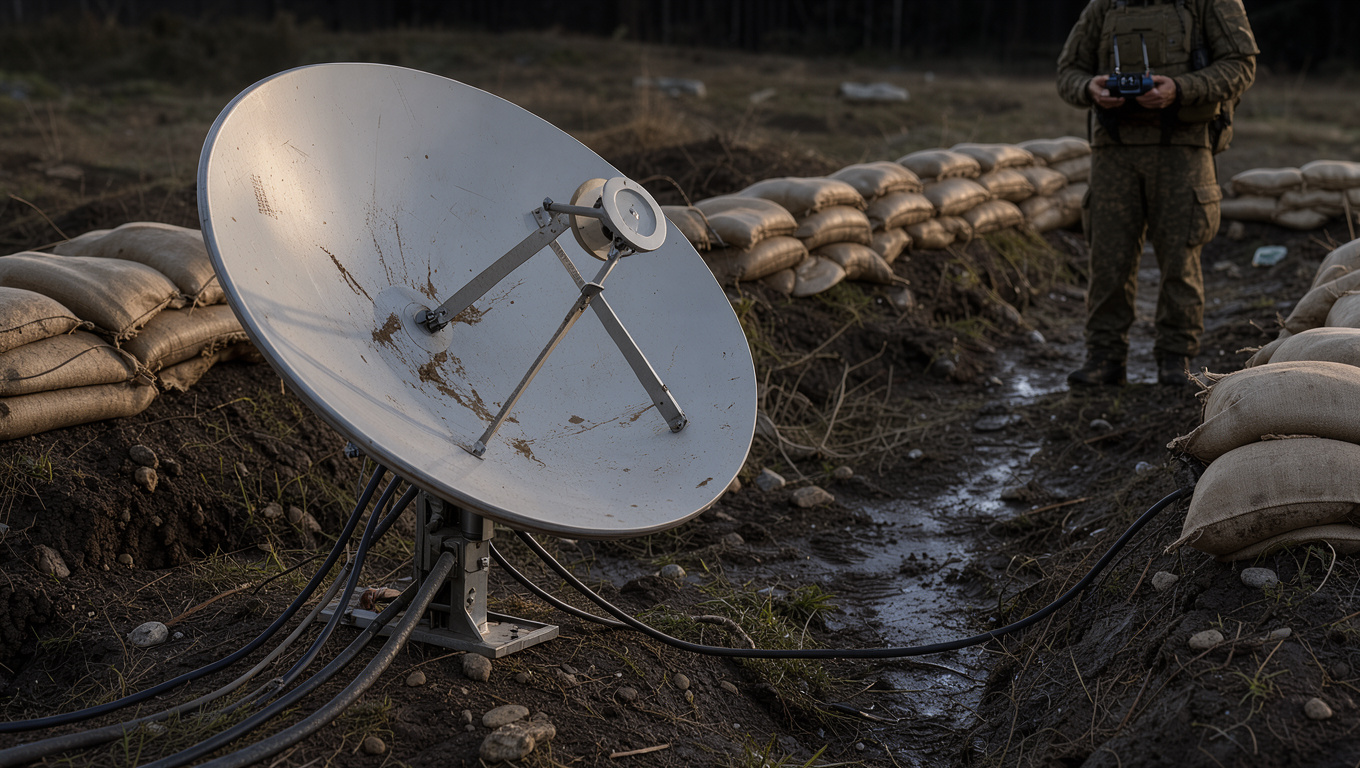
For eleven days, from 14 to 24 October, Starlink was heavily restricted in Ukraine, and the case weighs on the European debate over dependence on American tech companies. The Starshield connection, the military version of SpaceX’s satellite network, was cut off above 160 km/h, which hindered the Ukrainian army’s use of drones.1 Europe has its own satellite network project, IRIS², but the first satellites are not expected until 2029.1
What happened to Starshield
Starshield is the military program of the Starlink satellite network, owned by Elon Musk’s company. According to Valigia Blu, during the period in question the connection was cut off when drones exceeded 160 km/h, which greatly reduced Ukraine’s ability to use them against Russian forces.1 The scale of the problem is measured by the figures cited by the same source: at the beginning of 2026, Ukrainian President Volodymyr Zelensky said that more than 80% of Ukrainian attacks are carried out with drones.1 The restrictions have returned. In a message on X, Zelensky denounced new “substantial restrictions” along the entire front line and in the occupied territories, and said the terminals are blocking again at 161 km/h.2 According to Zelensky, the blocks are systematic, and the army rules out that they are accidental errors. The biggest problem, he explained, concerns the interception of Russian jet-powered drones, which travel well beyond that threshold: Ukrainian interceptors must reach similar speeds, and some attacks were not stopped.2
Who decided the block
According to Valigia Blu, it is not clear who made the decision. Musk has blamed the American government, arguing that the management of Starshield falls directly under the administration.1 The New York Times reported that President Donald Trump had reportedly called Musk to ask him to restore the system’s functions, and the Wall Street Journal later confirmed this. For Valigia Blu, this suggests the involvement of the SpaceX founder.1 The suspension came while Trump and Zelensky were in a dispute over the agreement between Washington and Moscow that would ease American restrictions on Russian diesel. Trump had asked Kyiv to stop raids on Russian refineries so as not to disturb the deal with the Kremlin.1
What IRIS² is and when it will be ready
IRIS² is a European program that has been under development for six years for a multi-orbit constellation, that is, a network of satellites distributed across orbits of different altitudes. It is meant to guarantee secure communications for governments, armed forces and critical infrastructure.1 With the agreement signed in August, the European Commission and the SpaceRISE consortium planned a fleet of 348 satellites: 330 in low orbits and 18 in medium orbits. There are fewer than Starlink has, but according to Valigia Blu they should be enough to guarantee European autonomy.1 The timeline is long: the first satellites in orbit are expected in 2029, and services should go live the following year.1
Other European projects
Other initiatives are still at a preliminary stage. In October 2025, Leonardo, Airbus and Thales signed a memorandum of understanding to create a “new European player in the space domain”, for now called Project Bromo, whose launch is expected in the second half of 2027. The Commission, the source reports, is reportedly working on simplified procedures to facilitate it.1 On 19 October, Deutsche Telekom, Orange, Telefónica and Vodafone opened the door to a joint offer for mobile satellite service frequencies in Europe. The four companies said they were willing to handle only the ground infrastructure, coordination and monitoring, and therefore not the orbital network.1 On 22 October, Ukraine’s Ministry of Defence co-signed with Finland’s ICEYE and with Nokia a letter of intent to explore a sovereign satellite communication system to strengthen the country’s defensive capabilities.1
What changes
Alternatives to the European constellation are also, for now, intentions, letters and proposed offers, with no network in orbit. The German newspaper Tagesspiegel notes that Europe wants to become less dependent on Starlink, but the road ahead remains long.13
This article was written by artificial intelligence from the sources cited, without human review. Automatic newsroom by Redazia.
Sources
Footnotes
-
Perché l’Europa deve liberarsi dei big tech USA: la lezione del blackout di Starlink in Ucraina, Valigia Blu, 2026-11-10 ↩ ↩2 ↩3 ↩4 ↩5 ↩6 ↩7 ↩8 ↩9 ↩10 ↩11 ↩12 ↩13 ↩14
-
Zelenski denuncia nuevas “restricciones sustanciales” en los satélites de Elon Musk que usa Ucrania, elDiario.es, 2026-11-12 ↩ ↩2
-
Alternativen zu Musks Starlink: Europas weiter Weg in die satellitengestützte Unabhängigkeit, Der Tagesspiegel, 2026-11-12 ↩