Hong Kong's Plastic Stool: From Poor Man's Seat to Object of Memory
Born in the 1960s under the Red A brand for the small homes of postwar Hong Kong, the plastic stool is now seen as a symbol of memory and belonging.
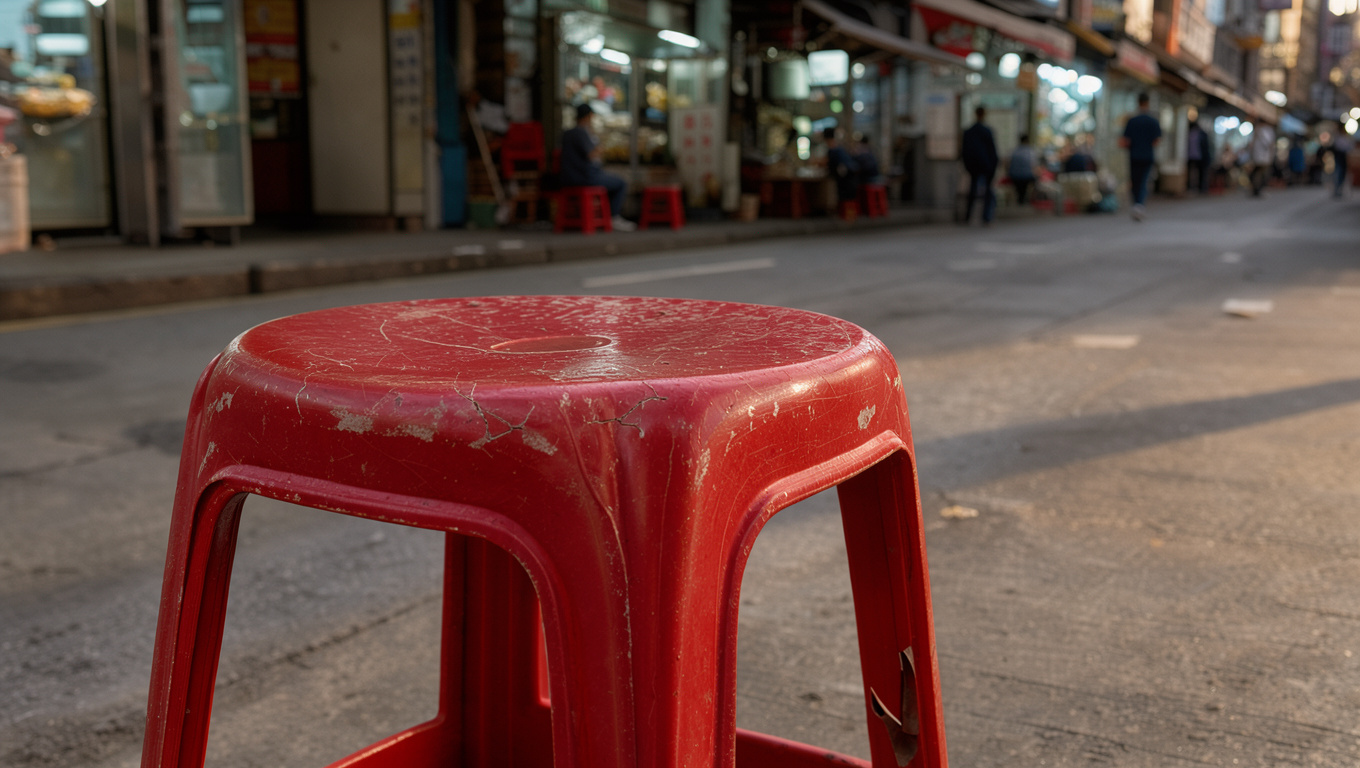
The plastic stool is one of the most recognisable objects in Hong Kong: you find it at food stalls, in neighbourhood markets and in homes. According to the South China Morning Post, it began as a cheap seat for the cramped apartments of the postwar years and has had a second life as an artistic vehicle for memory and belonging.1
Where you find the plastic stool
The paper cites three scenes: a meal at the Queen Street Cooked Food Market in Sheung Wan, an alley in Tsim Sha Tsui used to avoid the crowds of Nathan Road, and a covered bus stop in a rural village in the New Territories. In each there is the same object, which, according to the author, invites anyone, of any age and background, to sit down and stop for a moment.1 A photograph in the article shows customers sitting on plastic stools at the Wong Kei restaurant, on Tang Lung Street, in Causeway Bay.1
How it came about and how it is made
It was first produced locally in the 1960s by Star Industrial, under the Red A brand of plastic goods. The idea was to offer an affordable choice to people with little money to spend and little space in the small apartments of postwar Hong Kong.1 The Red A collection included different shapes and sizes. The most iconic version, the paper writes, is the taller, rounded, four-legged one, usually red. In the middle of the ribbed seat there is a small hole, which lets water drain away or allows a stack of stools to be tied together with a chain.1 By the Seventies the stool was a common sight in restaurants, markets, shops and homes. According to the article, its spread was driven by practicality and durability, including for models not made by Star Industrial.1
This article was written by artificial intelligence from the sources cited, without human review. Automatic newsroom by Redazia.