Anatomy and Art in Ancient Books: an Exhibition in Venice on the Beauty That Heals
In Venice, at the Scuola Grande di San Marco, an exhibition of ancient anatomical atlases tells the story of the joint work of artists and anatomists. Open…
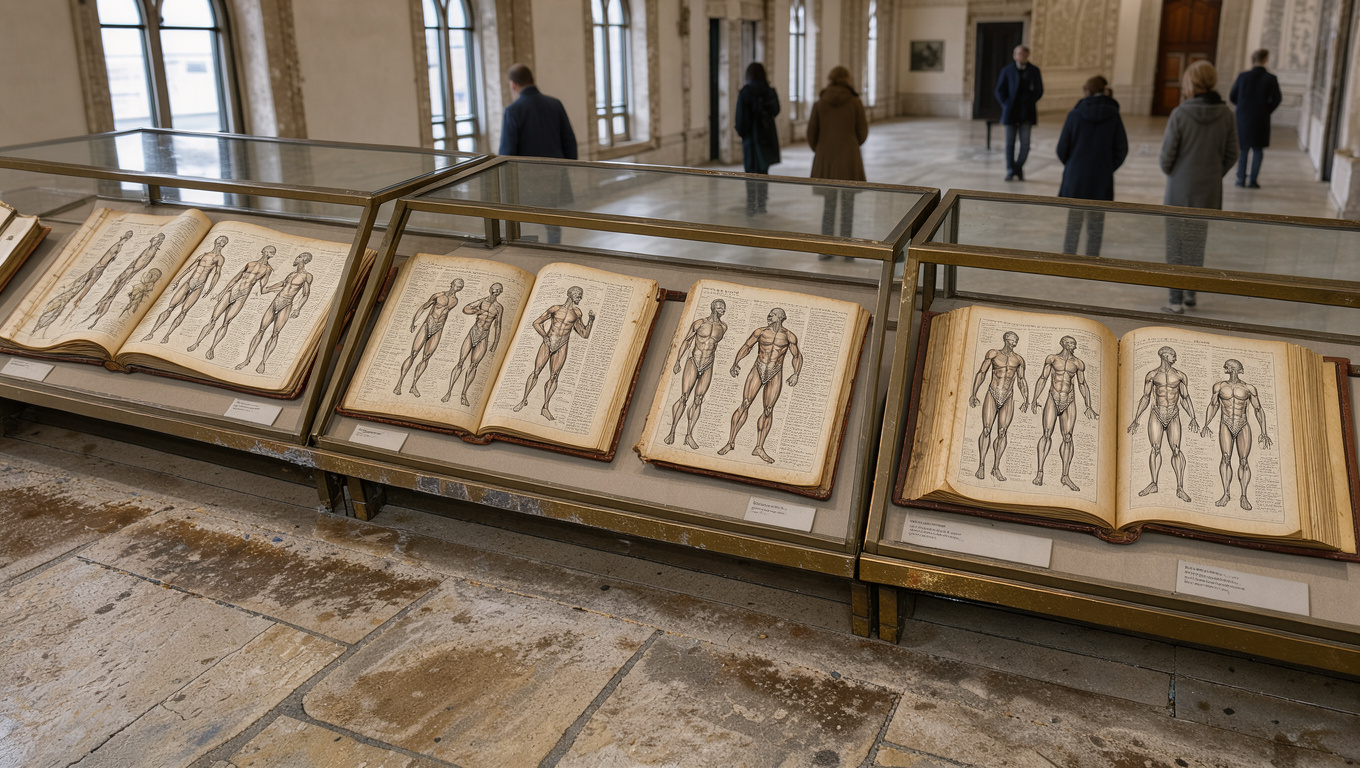
Visitors who want to see the exhibition on anatomy and art in ancient books have until 16 January 2027: the display occupies the Sala Capitolare of the Scuola Grande di San Marco, in Venice. It is titled “The Beauty That Heals” and is dedicated to the Scuola’s ancient volumes, where the science of the body and art meet.1 It shows how, for centuries, artists and anatomists worked together to represent the human body, in works where scientific precision was combined with the pursuit of beauty.1
What can be seen in the exhibition
The exhibition presents a selection of historical anatomical atlases, that is, volumes of illustrated plates of the human body. Some are being shown to the public for the first time and come from the monumental library of the Scuola Grande.1 The route begins with the first anatomical plates with movable parts and reaches the great illustrated volumes of the nineteenth century. It thus shows how knowledge of the human body grew and what role artists played in making it circulate.1 The director of the Scuola Grande, Mario Po’, speaks of a beauty with therapeutic value, to be rediscovered as a resource and not as a mere hypothesis. For this reason, he explains, it was decided to start from the origins of anatomical illustration, when it was evident that body, mind and soul form a unity, then as now.1
Venice, a city of anatomy
The route also recalls a lesser-known aspect of Venetian history. Anatomical studies in the city are documented as early as 1325, the year in which rules were established involving doctors, surgeons and other professionals in dissections.1 Over the course of six centuries the city had more than thirty sites where anatomy was practised: hospitals, convents and the anatomical theatre of San Giacomo dell’Orio. This history gave rise to the nickname “Urbe anatomica”.1 Alongside scientific activity, publishing grew. From the sixteenth century and for more than two hundred years Venice remained among the largest printing centres in Europe, and this favoured the circulation of medical knowledge and anatomy treatises.1
Where and until when can the anatomy exhibition in Venice be visited?
The exhibition is held in the Sala Capitolare of the Scuola Grande di San Marco, in Venice, and is open until 16 January 2027.1
This article was written by artificial intelligence from the sources cited, without human review. Automatic newsroom by Redazia.