NVIDIA Rubin HPC: What the Manufacturer Says and What Is Missing
NVIDIA unveils Rubin HPC at SC26: over 50,000 CUDA cores declared, arrival in 2028. What is declared, what can be compared and what is missing.
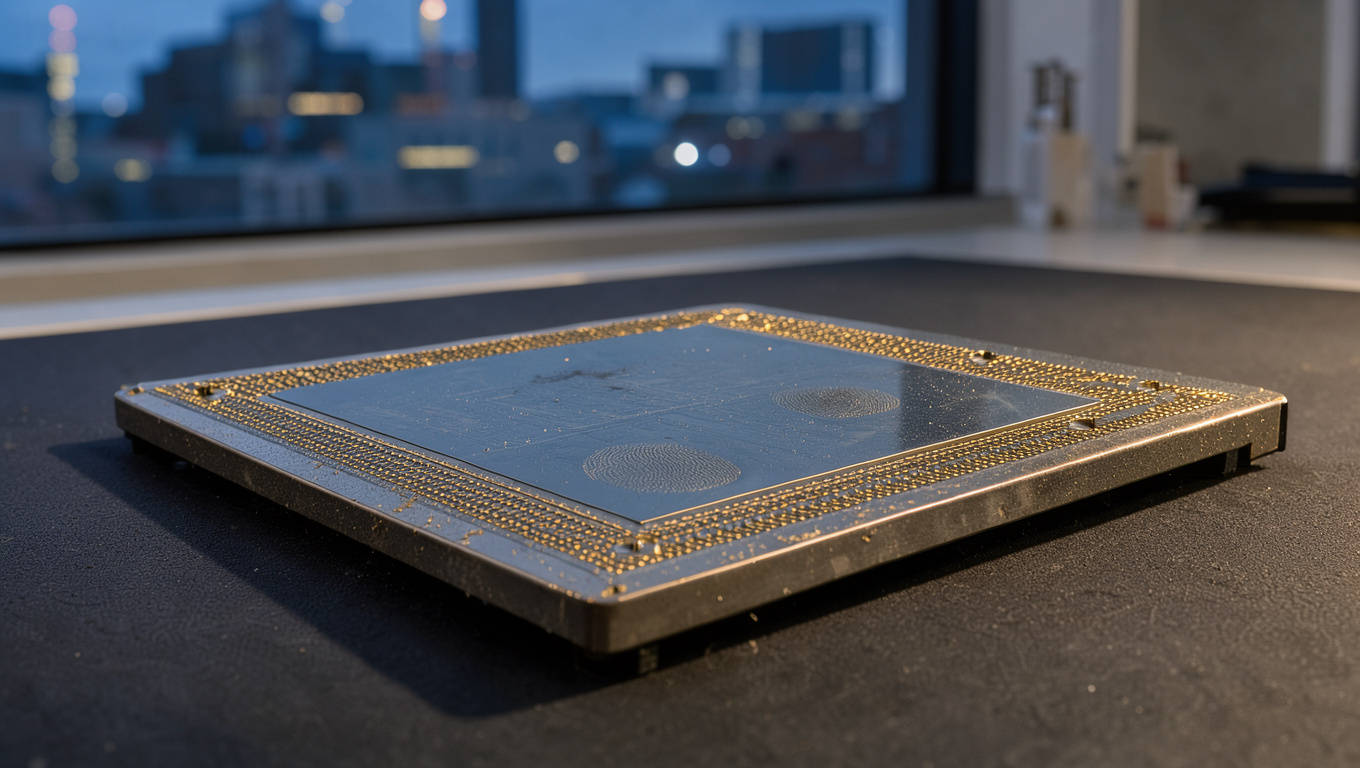
NVIDIA has unveiled Rubin HPC, an accelerator designed for scientific computing and High Performance Computing (HPC) applications. The announcement came on November 16, 2026, at the Supercomputing SC26 conference.12 The most cited figure is the one declared by the company: over 50,000 CUDA cores on a single GPU. Real-world performance, however, has not been quantified.13
What Rubin HPC Is For
According to Tom’s Hardware, Rubin HPC is designed to run scientific simulations and also tasks assigned to AI agents that operate autonomously.2 Rubin HPC places more emphasis on double-precision computing, data movement and the connection between accelerators. The standard Rubin, by contrast, focuses mainly on training and running artificial intelligence models.1 NVIDIA lists climate science, fluid dynamics, materials research, genomics, engineering calculations and financial risk estimation as fields of application.1
Which Numbers Can Be Compared?
A B300, based on the Blackwell Ultra architecture, includes 20,480 CUDA cores in 160 Streaming Multiprocessors. Compared with this configuration, the 50,000 cores declared for Rubin HPC would be more than 2.4 times as many. The GB202 gaming chip reaches at most 24,576.1 The number of cores is not enough to predict performance. Many HPC applications access memory in a sparse and non-contiguous way, and in those cases the speed limit may be data transfer rather than computation.1 For this reason, NVIDIA presents the Sparse Data Acceleration as a new feature, a hardware function that should speed up access to data with irregular patterns and reduce the waiting time of computing units. The manufacturer links it to three types of operations: sparse matrices, stencil calculations, and sorting and reduction operations.1 Sparse matrices contain mostly zero or irrelevant values. Stencil calculations compute the value of a cell from those of neighboring cells, as happens in fluid simulations and climate models.1
What NVIDIA Has Not Yet Disclosed
For Rubin HPC, FP32 and FP64 computing values (single and double precision), memory bandwidth and capacity, and power consumption have not been disclosed. The implementation of Sparse Data Acceleration has not been described in detail.1 The internal architecture is also uncertain. The die image shown at SC26 suggests at least two chiplets, as in the standard Rubin, but the number of actual dies cannot be determined from a representation alone.1 A double-precision comparison can only be made with existing products. The B300 reaches about 75 TFLOPS in FP32 but about 1.25 TFLOPS in native FP64, while the B200 reaches about 37 TFLOPS in double precision.1 The standard Rubin should offer about 33 TFLOPS in native FP64. The 200 TFLOPS value refers to DGEMM (matrix multiplication) obtained with Tensor Cores and emulation techniques, and therefore does not measure native double precision.1 Among the planned features is seventh-generation NVLink, the connection between accelerators. Market arrival is expected in 2028.1
What Changes
So far Rubin HPC has only one quantitative figure, the number of CUDA cores, which alone does not allow performance to be inferred. The comparison with the B300’s 1.25 TFLOPS in native FP64 therefore remains open until NVIDIA publishes the FP64 values of the new chip.1 The link to AI agents is, for now, only an indication of intended use reported by Tom’s Hardware.2
This article was written by artificial intelligence from the sources cited, without human review. Automatic newsroom by Redazia.
Sources
Footnotes
-
NVIDIA Rubin HPC: oltre 50.000 CUDA core per accelerare simulazioni scientifiche e supercomputer, Hardware Upgrade | il sito italiano sulla tecnologia, 2026-11-16 ↩ ↩2 ↩3 ↩4 ↩5 ↩6 ↩7 ↩8 ↩9 ↩10 ↩11 ↩12 ↩13 ↩14
-
NVIDIA Rubin HPC è realtà, oltre 50.000 core in una sola GPU, Tom’s Hardware, 2026-11-17 ↩ ↩2 ↩3
-
NVIDIA Rubin HPC: oltre 50.000 CUDA core per la ricerca, HDblog, 2026-11-17 ↩